
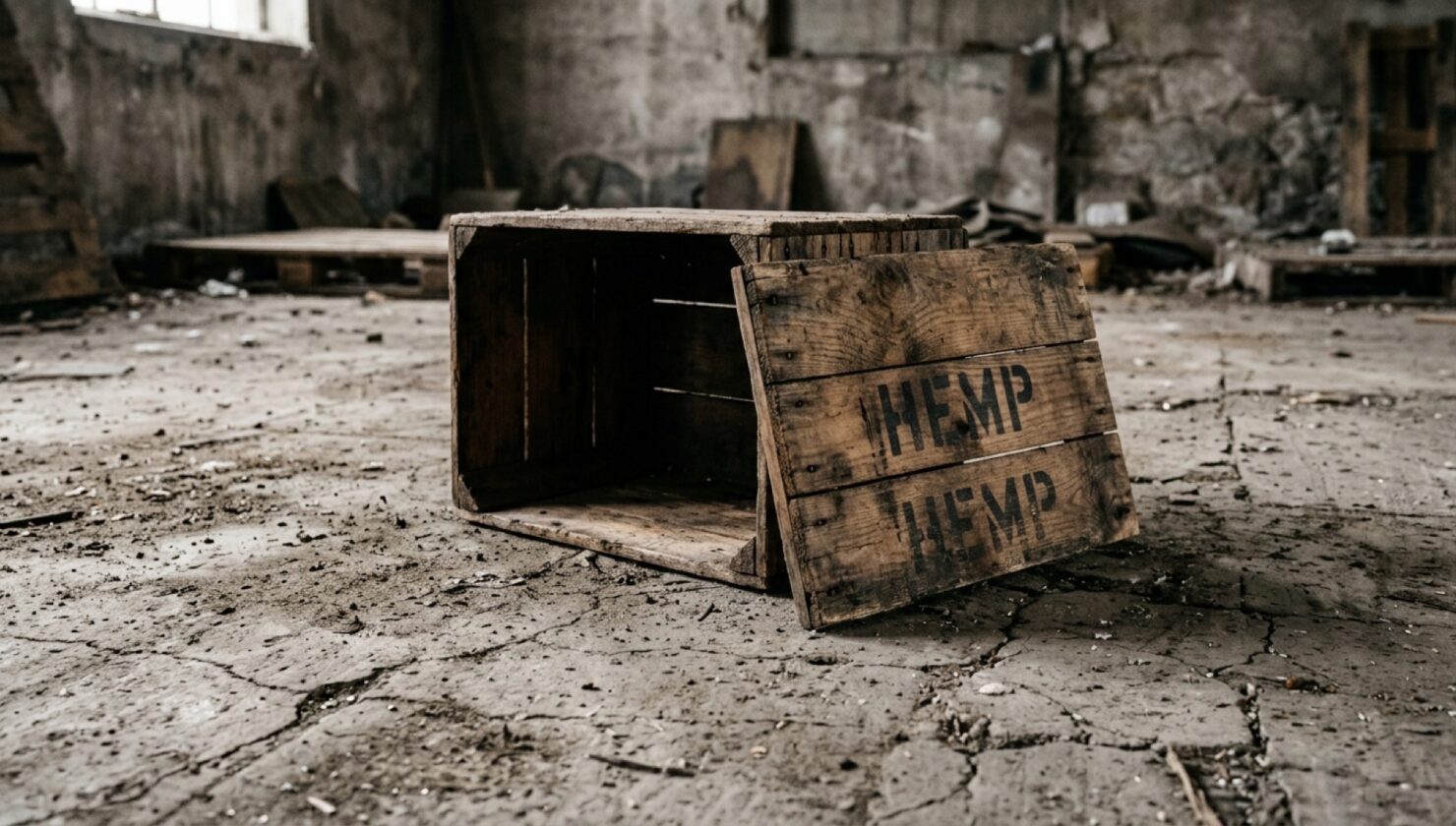
Picture a gummy manufacturer in eastern Kentucky. She employs eleven people, operates out of a building she’s leased for four years, and sells hemp-derived hemp THC legality by state and THCA products to smoke shops and convenience stores across six states. Her operation is fully licensed. Her products are tested. She pays her taxes, follows her state’s rules, and has never received a complaint from a regulatory agency.
On November 12, 2026, she becomes a federal criminal if she keeps selling.
She may not know it yet. Her suppliers may not know it yet. The smoke shops buying her gummies almost certainly don’t know it yet. That’s the problem.
What Happened, and When
On November 12, 2025, President Biden signed P.L. 119-37 — formally the Continuing Appropriations, Agriculture, Legislative Branch, Military Construction and Veterans Affairs, and Extensions Act, 2026. It was a must-pass government funding our legislative tracker. Without it, the federal government would have shut down. It passed the Senate 74-25. It ran 357 pages.
Section 781 of Division B, tucked inside the agricultural provisions, rewrote the federal definition of hemp.
The new definition becomes operative one year after enactment: November 12, 2026. That is now seven months away.
The changes are not subtle.
Total THC replaces delta-9 THC as the controlling metric. Under the 2018 Farm Bill, hemp was legal if it contained no more than 0.3% delta-9 THC. Processors and retailers quickly discovered that THCA — a cannabinoid that exists in raw flower and converts to delta-9 THC when heated — didn’t count under that test. Neither did delta-8, delta-10, or a dozen other cannabinoids. The hemp-derived cannabinoid market was built substantially on that gap. Section 781 closes it. After November 12, 2026, if a product exceeds 0.3% total THC after decarboxylation — the heating process that converts THCA to delta-9 — it is federally marijuana under the Controlled Substances Act.
The per-container limit is 0.4 milligrams of total THC. This is the provision most people in the industry haven’t fully absorbed. A typical delta-8 gummy contains 25mg per piece. A standard hemp-derived vape cartridge runs 50mg or more. The new federal cap — 0.4mg per container — would make virtually every intoxicating hemp product currently on the market federally illegal, regardless of what state it’s sold in. The ceiling is so low it also sweeps up an estimated 90% of “full spectrum” CBD products, even ones marketed purely for wellness with no intoxicating effect whatsoever.
Synthetic cannabinoids are fully prohibited. If a cannabinoid was made through a chemical process rather than extracted directly from plant material, it is out. Delta-8, which is predominantly produced by isomerizing CBD in a lab, is gone. So is HHC, THC-O, and any other lab-converted compound — even if the resulting molecule is chemically identical to one that occurs naturally in the cannabis plant.
Intermediates — bulk distillates and extracts — are restricted to business-to-business transactions only. The pipeline from hemp processor to consumer product manufacturer still exists on paper, but the end product it produces cannot reach consumers under the new rules.
How It Got There
The provision came from Rep. Andy Harris (R-MD), who chairs the House Agriculture Appropriations subcommittee. Harris has been a consistent critic of the hemp-derived cannabinoid market for years, arguing that it was exploiting the 2018 Farm Bill’s definition to sell products indistinguishable from marijuana.
He found a significant ally in Senate Minority Leader Mitch McConnell — the same Mitch McConnell who authored the 2018 Farm Bill provision that created the legal hemp market in the first place. McConnell, whose state of Kentucky has one of the largest hemp industries in the country, characterized the resulting market as an “exploited loophole” and declined to oppose the change. Thirty-nine state attorneys general had written a letter supporting stricter federal hemp regulation.
Sen. Rand Paul attempted to strip the hemp language by emergency amendment on the Senate floor. The amendment was tabled 76-24.
In the House, the bill passed without serious opposition. Representatives Thomas Massie and Greg Steube were among the few Republicans to vote no. Massie cited Section 781 by name in his floor statement.
The bill was must-pass. That was the point.
The Gap Between Federal Law and Retail Reality
Here is where readers of this column live: federal law changed in November. State laws have not.
You can walk into a smoke shop in most of the country right now and buy delta-8 gummies that are, as of November 12, 2026, federally controlled substances under the Controlled Substances Act. You can buy THCA flower — which converts to delta-9 at ratios well above 0.3% — across the counter in states where hemp is legal but cannabis isn’t. Nobody is stopping you. Nobody is stopping the retailer.
The enforcement gap is enormous, and it will stay enormous until the effective date arrives — and, almost certainly, for some time after. Federal hemp enforcement has never been robust. The DEA does not have a dedicated hemp retail task force. States without their own intoxicating hemp bans — like those detailed in Tennessee’s THCA and delta-8 ban — have limited incentive to enforce federal standards that their own markets depend on.
But the business-to-business layer of the industry is already feeling it. Capital markets began freezing in early 2026. Insurance carriers have started excluding or repricing hemp-derived cannabinoid product liability coverage. Distribution agreements are being terminated — not because November is here, but because the downstream liability of being caught in a product chain post-deadline is not a risk most commercial partners want to carry. Farmers who planted hemp in 2024 under THCA production contracts are trying to figure out what their 2025 crop is worth in a market that has no clear future.
The people being hurt right now are not trafficking organizations. They are farmers, small manufacturers, and retail operators who have been compliant with federal law as it existed — and who are now watching that law change underneath them.
What’s Being Done
There is one active legislative vehicle aimed at reversing Section 781: H.R. 6209, the American Hemp Protection Act of 2025, introduced by Rep. Nancy Mace (R-SC) on November 17, 2025 — five days after P.L. 119-37 was signed. The bill would repeal Section 781 entirely and restore the 2018 Farm Bill definition.
It has not moved out of committee.
H.R. 6209 has no Senate companion bill. McConnell’s continued opposition functions as a near-death sentence for any Senate path. The House Agriculture Committee, meanwhile, passed its version of the 2026 Farm Bill without a provision to delay or repeal the Section 781 changes, making clear that the Farm Bill is not a rescue vehicle. Some in the industry had hoped to use Farm Bill negotiations as leverage; that window appears to have closed.
The FDA was required under P.L. 119-37 to issue guidance within 90 days of enactment — by February 10, 2026 — defining which cannabinoids are permitted under the new framework and clarifying what “container” means for purposes of the 0.4mg cap. As of this writing, that guidance has not been publicly released. The ambiguity around “container” is not trivial: does it mean the entire package or each unit inside it? The difference between those interpretations is the difference between a full-spectrum CBD tincture being compliant or not.
Honest Assessment
The realistic path to relief before November 12, 2026, is narrow to the point of being notional.
H.R. 6209 would need a Senate companion, Senate floor time, and a presidential signature — all in a Congress that has other priorities and a Senate leadership structure that treats the existing hemp framework as an abuse to be corrected rather than a market to be protected.
The Farm Bill isn’t the answer. Court challenges are possible but slow — the boomtown vapor lawsuit in Texas is one early test — and a preliminary injunction against a properly enacted federal statute faces a high bar.
What this means in practice: businesses that depend on THCA, delta-8, synthetic cannabinoids, or high-dose hemp products need to assume the cliff is real and plan accordingly. The seven months between now and November 12 are not a negotiating period. They are a wind-down window.
What to Watch and When
April–May 2026: FDA guidance on permitted cannabinoids and the “container” definition. This is the most consequential near-term document for the industry. Watch for it; its absence beyond 90 days raises its own legal questions.
Spring 2026: Any sign of movement on H.R. 6209 in committee — a hearing, a markup, a companion Senate bill introduction. None has been scheduled as of publication.
Summer 2026: State-level legislative responses. Several states are already moving to establish their own frameworks for hemp-derived cannabinoids. Those frameworks will determine what happens at retail post-November in the absence of federal enforcement capacity.
November 12, 2026: The effective date. On that day, the legal status of most intoxicating hemp products in the United States changes under federal law, whether or not the retail market reflects it immediately.
This is what the law says. The gap between what the law says and what you can buy at the gas station down the street is the story — and it is going to get harder to ignore.
Morgan Ellis covers hemp regulation and federal cannabis policy for CannabisInquirer.com. The Grey Zone publishes when the law is moving faster than the people it affects.


Responses