
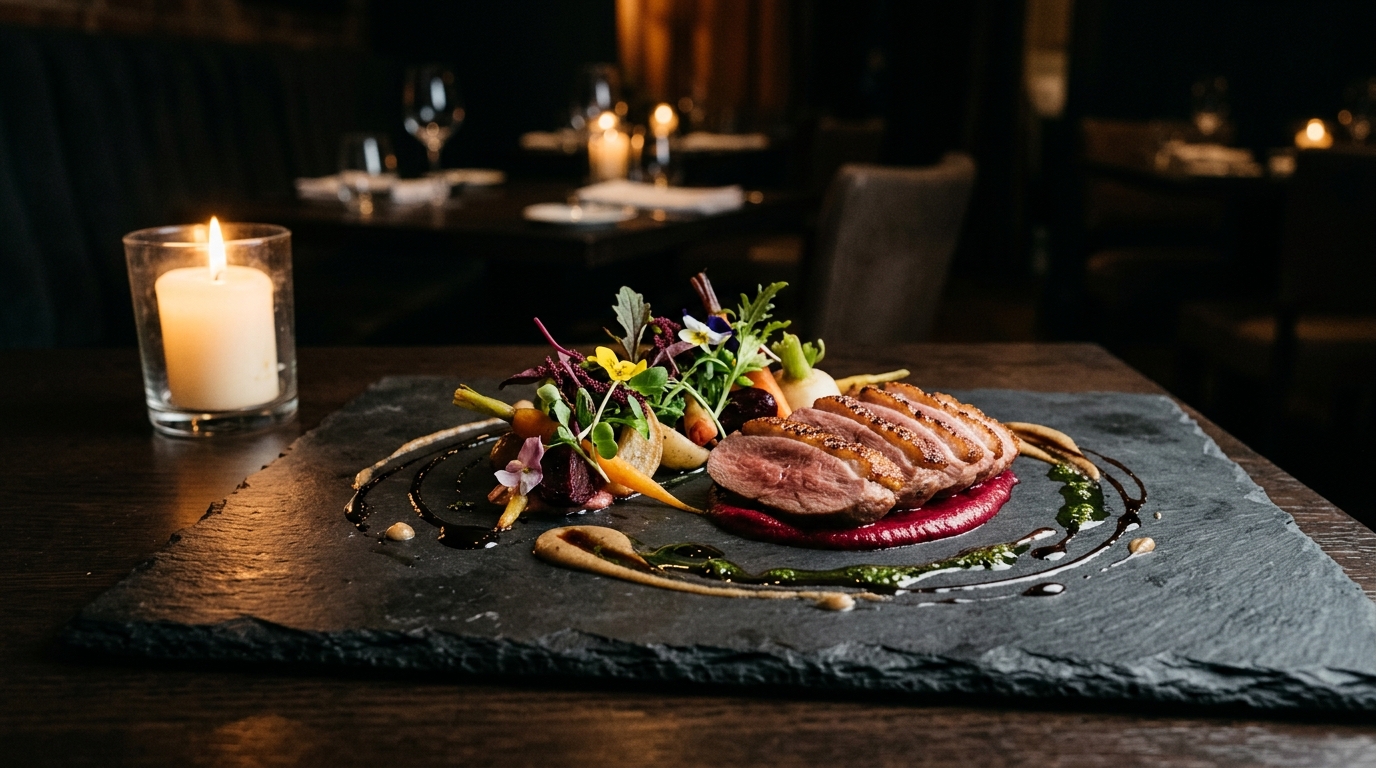
Cannabis-infused tasting menus are now standard in fine dining restaurants across legal markets, with chefs dosing THC at 2-3mg per course and treating cannabinoids as deliberately as wine or spice. This approach demands technical skill—extraction methods, temperature control, and flavor integration—that separates Michelin-level cannabis cooking from consumer edibles.
This is not the cannabis dining of popular imagination — the novelty brownie, the secret dinner party, the giggling circle around a pot of fondue. This is something else: a formal, considered attempt to integrate cannabis into fine dining with the same discipline that the industry has applied to wine, spirits, and fermentation. And it is, slowly, finding an audience.
A Movement With History
Cannabis-infused dining has been practiced in various forms for as long as people have cooked with the plant. Bhang, a traditional cannabis preparation consumed in India during religious festivals, dates back centuries. Mid-century American counterculture had its cannabis cookbooks. The medical cannabis movement created a generation of patient practitioners who learned to extract, emulsify, and dose cannabinoids with genuine precision.
What’s new is the crossover into professional culinary culture. Trained chefs with resumes spanning Michelin-starred kitchens are now incorporating cannabis into their practice — not as a novelty revenue stream, but as a serious ingredient with distinct flavor profiles, complex aromatic compounds, and nuanced interaction with food chemistry.
The James Beard Foundation acknowledged the shift in 2025 by hosting its first public symposium on cannabis and culinary arts, bringing together chefs, hospitality professionals, and cannabis cultivators to discuss technique, sourcing, and the regulatory landscape. The fact that the Foundation — historically conservative about anything adjacent to controversy — hosted the event at all was significant.
The Technical Challenge
Cooking with cannabis is harder than it looks, and the gap between amateur and professional preparation is meaningful.
The primary challenge is dosing. Cannabis infusions are not precise in the way that alcohol content in wine is precise. Variations in starting material potency, extraction efficiency, and distribution within a finished dish create unpredictable results. A chef preparing 40 servings of a cannabis-infused sauce needs to control for variables that a conventional recipe doesn’t require.
Professional practitioners use standardized cannabis concentrates — distillate or broad-spectrum extracts with verified cannabinoid content — rather than infusing from raw flower. Combined with culinary-grade nano-emulsification, which creates water-soluble cannabis that disperses evenly in sauces, stocks, and emulsions, this approach can achieve dosing precision within ±0.5mg per serving.
The second challenge is flavor. Raw cannabis has a distinctive terpene profile — earthy, piney, sometimes citrusy — that can overwhelm delicate preparations. Professional cannabis chefs select strain-specific extracts to complement rather than clash with the dish’s flavor architecture. A citrus-forward terpene profile might be chosen for a ceviche; an earthy, herbal profile for a mushroom consommé.
“It’s not fundamentally different from thinking about wine pairing,” said one San Francisco chef who offers a cannabis tasting menu on weekend evenings. “You’re asking what aromatic compounds are in this dish, and what aromatic compounds would complement or contrast interestingly. It’s just that with cannabis, the ingredient is also doing something pharmacological.”
The Regulatory Maze
Social consumption — cannabis consumed in public venues — remains restricted in most states, creating significant barriers to cannabis dining as a licensed, public-facing business. California allows licensed cannabis retailers to apply for a consumption lounge license, but the licensing process is complex, local approval is required, and the overlap between food service licensing and cannabis licensing creates jurisdictional complications.
Colorado’s Denver has operated a social consumption pilot program since 2021, with participating venues authorized to allow on-site cannabis use under a separate permit. The program has been limited in size but has provided proof of concept: venues operating within the framework have reported few incidents and strong customer satisfaction.
Nevada has been most aggressive in developing the social consumption framework, driven in part by Las Vegas’s hospitality economy and the obvious tourist market for cannabis experiences. Several Strip-adjacent venues operate licensed cannabis lounges, though full cannabis dining — where the restaurant itself infuses food, rather than guests bringing their own products — remains in a gray zone.
The Practitioners
The chefs defining this nascent field are a varied group. Some come from the cannabis industry itself, trained in extraction and product development who taught themselves culinary technique. Some are conventionally trained chefs who arrived at cannabis through personal use or curiosity. A few are hospitality entrepreneurs who identified the market opportunity and assembled teams to pursue it.
What they share is a seriousness of purpose that separates the category from its novelty predecessors. The best cannabis dining experiences are, by design, cannabis-optional: the food stands on its own, the service is professional, the environment is considered. Cannabis is a dimension of the experience, not its entire rationale.
That approach, practitioners argue, is the path to normalization. When cannabis dining can be evaluated by food critics on the same terms as any other dining experience — quality of ingredients, skill of execution, coherence of concept — the plant ceases to be the story, and the meal becomes one.
The tablecloth is linen. The glassware is handblown. That’s a start.



Responses