
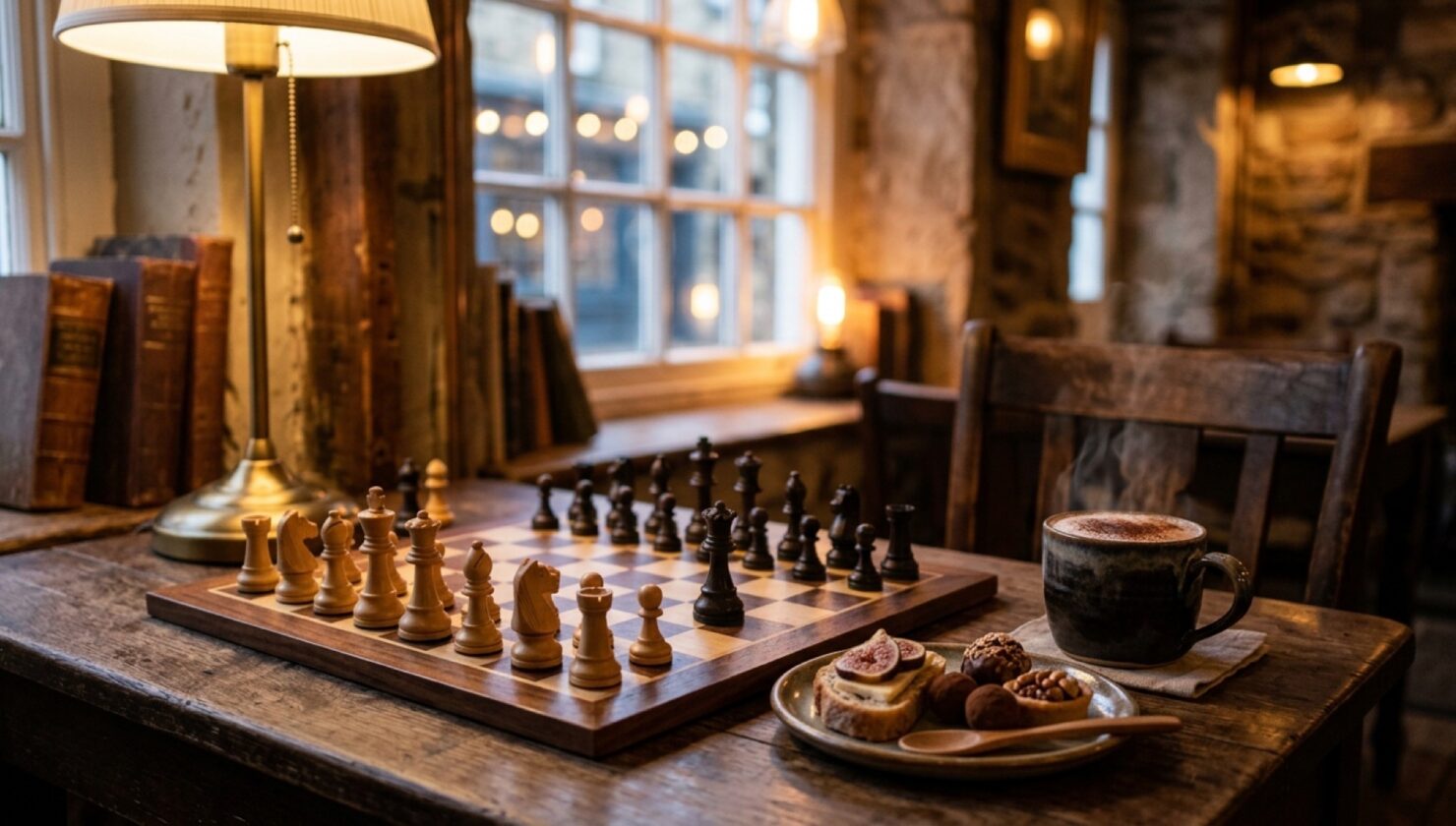
High Stakes: The NYC Chess Teacher Who Gets You Stoned Before You Study the Board
There’s a version of this story where Sam Adler is just a chess teacher with a gimmick. Get people high, sit them down at a board, collect the entry fee, go home. That version misses the point entirely.
Adler runs Puff and Chess, a series of events held across New York City where participants are invited to smoke before — and during — a guided introduction to the Royal Game. The concept sounds like a novelty, the kind of thing that gets a cheeky write-up and disappears within a season. But it hasn’t disappeared. If anything, it’s grown. And when you understand why it works, the chess part starts to feel almost secondary.
“Cannabis helps people drop their guard,” Adler has said, framing his whole methodology in a single sentence. That’s the thesis. Everything else is execution.
The Unexpected Learning Advantage
Most adults who don’t know how to play chess don’t learn for one simple reason: they’re embarrassed to be a beginner in public. Chess carries a cognitive prestige burden. It’s the game of geniuses, of cold-war grandmasters, of the kid in school who always seemed a little too composed. Sitting down at a board as a novice, in front of strangers, means admitting you’re not that. The ego resists.
Cannabis, in a social setting with the right facilitation, tends to soften that resistance. Not because it makes people stupid — the tired stereotype runs the opposite direction of what Adler is working with — but because it interrupts the self-monitoring loop. The voice that says don’t look dumb gets quieter. Curiosity has room to come in.
This is the neurological reality that’s increasingly being documented. When cannabis interacts with the brain’s reward and attention systems, it doesn’t uniformly fog cognition. At moderate doses, in familiar social environments, many users report a reduction in social anxiety alongside heightened engagement with whatever’s immediately in front of them. For learning a new game, that’s a feature, not a bug.
Adler isn’t operating from a clinical framework — he’s a chess teacher running events, not a researcher — but what he’s intuited aligns with how cannabis affects novelty-seeking and engagement. The plant has always been intertwined with play. Puff and Chess just made that formal.
Chess as a Cannabis Cultural Artifact
This is also, in a quieter way, a story about lineage. Adler’s father wrote record reviews for High Times in the 1970s. His mother hosts a PBS cooking show. He grew up in a household where countercultural media was just media, where the kitchen was a place of craft, and where both domains were treated seriously. That background matters.
The 1970s cannabis culture that his father wrote within was expansive in a way that’s easy to forget. It encompassed music, politics, spirituality, and art. It was the culture that gave you High Times as a publication that ran serious fiction alongside grow guides, that treated cannabis users as curious, thinking people rather than burnouts looking to check out. That era seeded a lot of what the current generation is now rediscovering: cannabis as a tool for presence, for creativity, for connection — not just for getting wrecked alone on the couch.
Puff and Chess is, in that sense, a direct descendant. A communal ritual with structure and learning at its center.
The NYC Social Scene Is Hungry for This
New York’s legal cannabis market has matured enough now that the novelty of the dispensary experience has worn off for early adopters. There are only so many times you can visit a beautifully designed shop before you want the culture that’s supposed to grow up around the plant. Consumption lounges have been slow to proliferate. Traditional social rituals — bars, coffee shops, shows — don’t always accommodate cannabis. The informal sesh in someone’s apartment hasn’t gone anywhere, but it doesn’t scale.
What Adler has built is a third option: a structured social event with a real activity at its core. You’re not just gathering to smoke. You’re gathering to learn something, to compete at something, to engage with a game that rewards patience and pattern recognition — qualities that align naturally with a thoughtful high.
The format also has a democratic appeal. Chess is free. You can play it anywhere. Once you learn it, you carry it with you forever. Teaching it to stoned adults in a low-stakes environment strips it of the intimidation factor and gives it back to people who may have assumed it wasn’t for them.
Puff, Play, and the Future of Cannabis Socialization
As the legal cannabis landscape continues to expand and normalize — even amid the federal policy turbulence that’s dominated headlines in 2026 — the question of what do we actually do together while high becomes more pressing. The plant is legal in the majority of U.S. states now. The social infrastructure to match is still catching up.
Events like Puff and Chess point toward one answer: give people an activity that’s enhanced by the plant, not just accompanied by it. Games, music, cooking, art — there’s a long tradition of cannabis amplifying focused, collaborative, creative engagement. The problem has been that so much cannabis marketing still defaults to pure relaxation and escapism, a legacy of the prohibited era when the whole point was to disappear from scrutiny.
Adler’s approach assumes something different: that cannabis consumers want to show up, learn things, be present, and connect. That the plant, handled right, is a door opener rather than a door closer.
Given that his events keep filling up in one of the most saturated entertainment markets in the world, it’s hard to argue with the evidence.
Sam Adler runs Puff and Chess events across New York City. Information on upcoming events is available through his social media.


Responses